
Dental Front Desk Burnout: How Phone Overload Crushes Your Best Staff
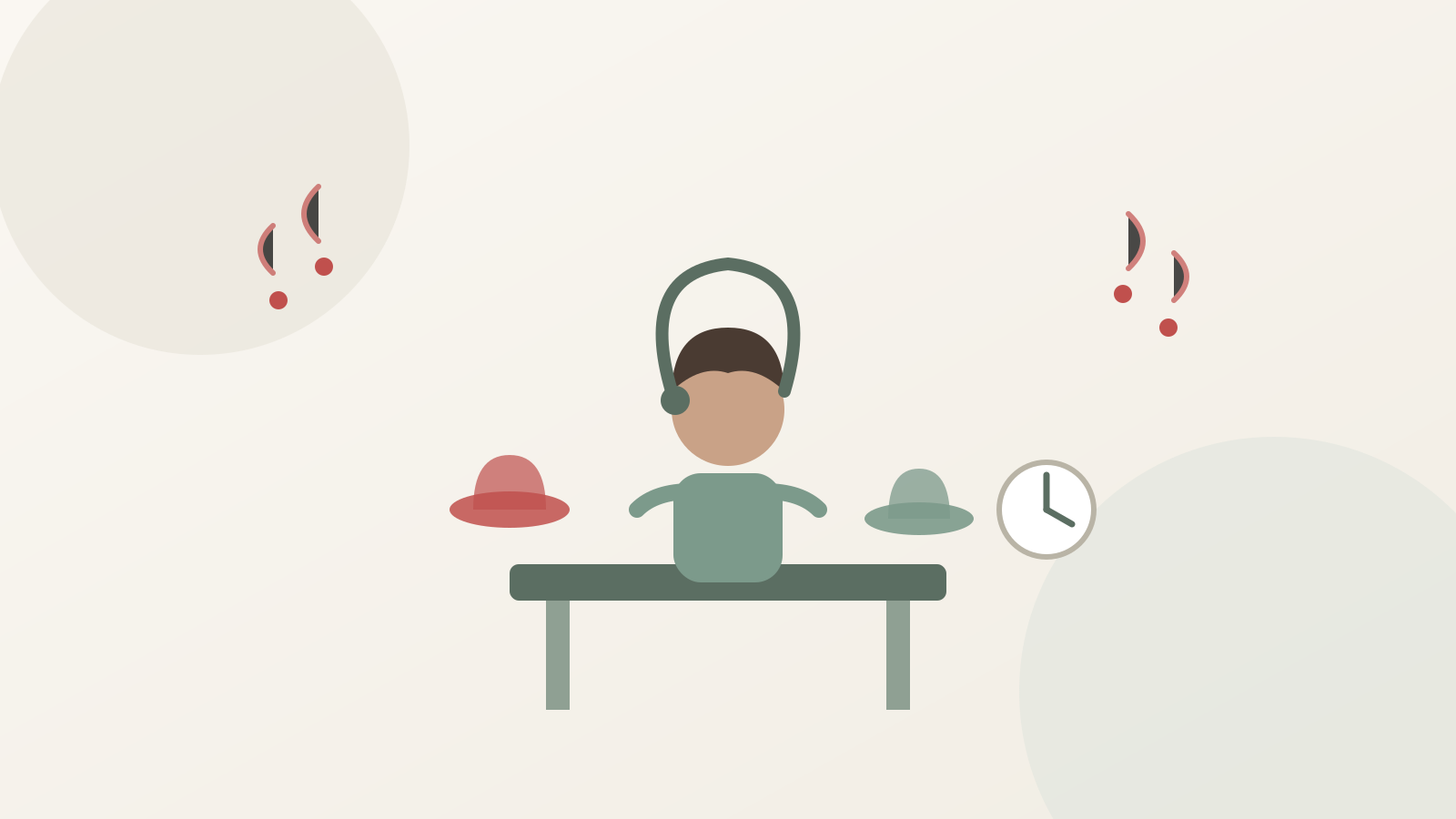
Your front desk coordinator is not a receptionist. Not really. She is the scheduler, the insurance verifier, the billing triage line, the recall coordinator, the check-in greeter, the treatment plan presenter, the problem solver — and the phone operator. All at once. And the phone does not care that she is mid-conversation with a patient's parent or halfway through an insurance claim. It rings, and every ring pulls her out of the task she was actually doing.
This is the quiet crisis in dental practices across Florida: front desk burnout is not caused by lazy staff or weak managers. It is caused by the job itself — an impossible stack of hats with the phone as the constant interruptor. And when your best front desk person burns out and leaves, the cost is measured in thousands of dollars, disrupted patient relationships, and months of chaos you never budgeted for.
The Six-Hat Problem Nobody Hires For
Walk into almost any single-owner or small-group practice and you'll find one or two front desk team members absorbing a workload that used to be split across a team of three. In a typical week, that person is expected to:
- Answer every incoming call. New patient inquiries, appointment changes, insurance questions, referral calls, vendor calls, and the occasional wrong number — all routed through one line and one human.
- Manage the schedule in real time. Filling cancellations, booking emergencies, confirming tomorrow's patients, and protecting the doctor's chair time — while patients stand at the window waiting.
- Verify insurance and estimate benefits. A task that routinely takes 10-20 minutes per patient and cannot be interrupted without starting over.
- Run the recall and reactivation lists. The marketing engine of a mature practice, and almost always the first thing dropped on a busy day.
- Handle patient check-in, payments, and paperwork. The face-to-face work that patients actually remember.
- Put out fires. A broken chair, a lab delay, a supplier issue, a patient complaint — whatever lands on the desk.
No one posts a job ad for "six-hat juggler." But that is the job. And the phone is the reason each hat is impossible to wear well.
Why Phone Interruptions Are Worse Than You Think
Here is what most practice owners miss: it is not the volume of calls that breaks people — it is the switching cost of every single interruption. Cognitive research is consistent on this. When a person is pulled out of a focused task, it takes several minutes to fully re-enter that task. A front desk coordinator interrupted by a two-minute phone call every ten minutes never actually reaches a state of focus. She lives in a permanent state of half-finished work: a claim form with three missing fields, a recall list she started and abandoned, a treatment plan she meant to present.
The result is not just fatigue. It is constant low-grade anxiety about dropping something important — because she is, in fact, dropping things. Insurance claims get filed late. Recall calls stop happening. Confirmation texts go out at 9 PM instead of 2 PM. The team member feels like she is failing at every hat, and the practice quietly bleeds revenue she never gets credit for protecting.
Worse, the interruptions keep escalating. Every year, Florida practices report more inbound phone traffic, not less — patients expect faster answers, same-day bookings, and instant confirmation. The phone used to be one of six hats. Now it is the job that eats the other five.
The Turnover Tax: What Losing Your Front Desk Actually Costs
Burnout has a price tag, and it lands on your P&L the day your best coordinator hands in notice. The obvious costs: recruiting fees, a slower front desk during the gap, and training a replacement who is useless at the phones for at least two months. The less obvious costs are worse:
- Institutional knowledge walks out the door. She knew which insurance plans are trouble, which patients prefer Tuesdays, how the doctor likes emergencies slotted. That knowledge is gone, and it takes a year to rebuild.
- Patient trust takes a hit. Patients build relationships with the voice that answers. A new face — and a new voice — after a rushed handoff reads as instability.
- The remaining team absorbs the load. One resignation quietly burns out the next person in line. Turnover is contagious.
Industry estimates for replacing a skilled dental front desk employee routinely land between $5,000 and $15,000 when you count recruiting, training, overtime, and lost productivity — and that is before you count the missed calls and un-verified claims during the transition. When your best staff member is drowning, the cheapest fix is never "hire faster." It is removing the load that drowns her.
What Changes When AI Takes the Routine Calls
This is where a modern AI receptionist stops being a "tech experiment" and becomes a staffing strategy. The goal is not to replace your front desk — it is to remove the highest-interruption, lowest-judgment work from her plate so she can do the work that actually needs a human.
- The phone gets answered on the first ring, every time. The AI handles the routine call types that eat hours: "What time are you open?", "Do you take my insurance?", "Can I move my cleaning?", "I need to confirm my appointment." Each one resolved politely and completely, with zero interruption to your coordinator.
- Bookings land directly in the schedule. The AI checks live availability and writes the appointment straight into your PMS — no double-booking, no sticky notes, no "I'll call you back."
- New patient inquiries get captured in the moment. The highest-value call in dentistry — a new patient actively shopping — never hits voicemail and never waits for a call-back.
- Humans handle the humans. Complex insurance questions, anxious patients, treatment plan discussions, check-in conversations — the work that builds trust and revenue stays with your team, minus the constant ringing.
The practical effect is a front desk that can actually finish a task. Claims get verified. Recall lists get called. Patients get a warm, unhurried welcome at the window. Your team stops surviving the day and starts running the practice.
The ROI: Retention Is Cheaper Than Replacement
Do the math on a single avoided resignation. If replacing your front desk coordinator costs $10,000 in hard and soft costs — and you keep her for another two years instead of losing her — that alone is a five-figure win. Now add what the recovered hours are worth.
A coordinator who handles 30-60 calls a day gets back a meaningful share of her day when routine calls are automated. Those hours go into insurance verification (fewer denied claims), recall and reactivation (more returning patients), and chair-side support (higher treatment acceptance). In a practice producing $800,000-$1.2M a year, a front desk that operates at full capacity instead of 60% is worth far more than the cost of an AI receptionist — which starts at roughly the price of a fraction of a part-time hire.
This is why we keep saying the comparison that matters is not "AI vs. a human." It is "AI plus a focused human vs. a burned-out human doing the work of three." The second one is what most practices are running today — and it is the one that loses patients, loses staff, and caps your growth. The human front desk versus AI-assisted front desk comparison goes through this line by line.
Two Objections We Hear From Practice Owners
"Won't my front desk feel replaced — or resent the AI?"
The opposite, in practice. The team members who are drowning in rings don't want more ringing; they want the ringing to stop. When the AI takes the repetitive calls and hands your coordinator a clean schedule and verified claims, the reaction is almost always relief — then enthusiasm. She didn't become a healthcare professional to be a switchboard. She became one to help patients. Give her back that job and watch her engagement climb.
"Will patients be annoyed talking to a machine?"
They will if it sounds like a machine. Modern conversational AI holds natural, human-like conversations — it can switch to Spanish mid-call, understand a nervous patient, and handle real questions with empathy. Patients care about one thing: that someone competent picked up and solved their problem. When that happens on the first ring, they don't miss the hold music. And when they need a human, they get one — immediately, not after fighting a phone tree.
The Bottom Line
Your front desk is the most undervalued revenue engine in your practice — and the most overloaded. Phone overload doesn't just cost you missed calls; it burns out the people who keep your schedule full and your patients happy. The fix is not to tell your team to "multitask better." It is to remove the constant interruption from their day so they can do the work that actually needs them.
The practices that win in Florida over the next five years won't be the ones working their front desk harder. They'll be the ones who gave their team a real job back. Book a live demo and see what your front desk can do when the phone stops controlling the day.